




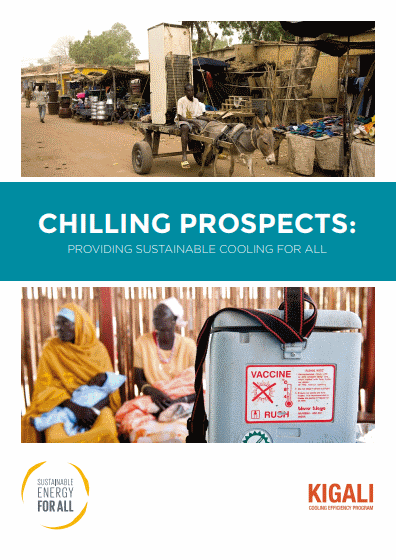
The report, Chilling Prospects: Providing Sustainable Cooling for All, is the first-of-its-kind study assessing the growing risks and the opportunities of the global cooling challenge.
Enlarge
“In a world facing continuously rising temperatures, access to cooling is not a luxury – it’s essential for everyday life. It guarantees safe cold supply chains for fresh produce, safe storage of life-saving vaccines, and safe work and housing conditions,” said Rachel Kyte, CEO and Special Representative to the United Nations Secretary-General for Sustainable Energy for All.
Based on an analysis of 52 vulnerable countries in hot climates, the report considers three distinct settings where the lack of air conditioning and refrigeration has profound implications for populations: health, including both protection from heat extremes and access to vaccines; food safety and security (e.g., absence of food cold chain or refrigerated storage); and productivity, in terms of ability to work and depressed incomes due to heat.
The poorest segments of the population in both urban and rural areas are those facing the highest cooling risks, with nine countries having the biggest vulnerable populations: India, Bangladesh, Brazil, Pakistan, Nigeria, Indonesia, China, Mozambique, and Sudan.
Solutions to ease immediate cooling risk include off-grid solar systems to power fans, refrigerators and “last mile” transport for vaccines in rural areas, as well as public cooling centers, sunlight-reflecting roofs and house retrofits in cities.
A different kind of cooling risk concerns a growing middle class in developing and emerging countries (2.3 billion people, defined as “carbon captives” in the report), whose limited purchasing options mean they may only be able to buy less expensive and less efficient cooling devices, which could spike global energy demand and consequent GHG emissions.
Commenting on the report, Jürgen Fischer, President of Danfoss Cooling and industry representative in the Cooling for All Global Panel, said: “Industry is ready for sustainable cooling. Energy-efficient and low global warming potential technology is available today and needs to be implemented globally”.
Agreed in 2016, the Kigali Amendment to the Montreal Protocol calls for phasing down production and consumption of hydrofluorocarbons (HFCs, largely used in air conditioners and other cooling appliances) with high Global Warming Potential (GWP) by more than 80 percent over the next 30 years.